|
Captain Ned Harris
Late Coldstream Guards
|
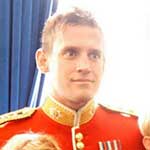
Captain ‘Ned’ Harris, who has died aged 40, was a former Coldstream Guards officer who fought in Ukraine alongside the International Legion.
In November 2022, nine months after Russia invaded Ukraine, Harris, aged 37, was a non-commissioned officer serving in the Ukrainian International Legion. A group of Ukrainian soldiers were cut off from their unit and pinned down in an apartment block close to the city of Bakhmut in Donetsk, eastern Ukraine. Harris and his team were on an operation to rescue them. Russian drones were spotted overhead on the approach to the isolated troops and Harris’s small force was ambushed.
A barrage of mortar, artillery and tank fire forced them to take cover under a disused railway bridge. As the shelling intensified, they were forced into the open. Two of Harris’s men were killed, and two others were badly wounded. Harris was unconscious. He had been hit by several bullets in the upper body, and his left leg was almost severed by shrapnel from an artillery round.
The dead and injured were evacuated to vehicles under relentless fire. They were taken to the military hospital in Dnipro, about 130 miles west. While he was there, he was manning two telephones and making sure that the wounded men were being looked after. Despite needing critical care, he refused to leave hospital without them.
Civil and military air travel was impossible, and they were moved by a Ukrainian volunteer ambulance crew to Warsaw, about 800 miles away, where they received further treatment. After being repatriated, Harris was moved to St George’s Hospital in London, where his left leg was amputated.
Edward (Ned) Gordon Charles Harris was born in London on 20th August 1985. He was educated at Harrow and completed a game ranger course in South Africa before going up to Newcastle University, where he read ancient history. He was a keen shot from an early age. Later on, he played polo, enjoyed photography and raced classic cars with his father.
Despite his rebellious disposition, he was drawn to the adventure and challenge that soldiering offered. After attending Sandhurst, he was commissioned into the Coldstream Guards in December 2010 and posted to the 1st Battalion. He commanded a platoon and was subsequently second in command of a company and operations officer in Afghanistan. On his return, restless, and impatient with authority and peacetime soldiering, he left the Army in 2014.
He spent time in Africa and Switzerland searching for something that would give meaning to his life. His instinct was always to support the underdog, and to stop wrong-doing at whatever cost. When Ukraine was invaded by Russia early in 2022, he felt compelled to act.
He drove to the Ukrainian border and offered to help with any humanitarian or training work in which he could use his skills. In March, he joined the International Legion as a private soldier.
Fighting alongside fellow Britons, Canadians, Americans, Hungarians, South Koreans and others, as well as his Ukrainian counterparts, he became an integral part of a small band of determined men. Under-resourced and under-equipped, between March and June they were involved in some of the fiercest fighting of the war.
Harris was initially deployed to Irpin to join the troops resisting the Russian push for Kyiv. The Legion fought alongside Ukrainian troops to repel the Russian advance, and it was in these first battles that Harris showed his ability to think clearly, plan logically and carry out missions with determination. At their first meeting, his comrades described their baffled admiration – on the surface, his ready charm, a devil-may-care attitude, a caricature of British sangfroid, but in action a consummate professional.
The fighting was a combination of First World War-type trench warfare, cramped living quarters, sandbags, barbed wire and mud, a wasteland of craters and charred, stunted trees, overlaid by the constant threat from shelling or precision attacks by drones capable of high-tech surveillance and equipped with bombs or missiles.
After tough fighting in Zaporizhzhia, Kharkiv and Mykolaiv, in July he returned to England on leave. In August, he returned to Ukraine equipped with six custom vehicles and upgraded ballistic equipment – privately purchased with his own funds and those raised by his family.
Having formed definite ideas of the new tactics required, he persuaded his commanders to let him form two units. They would operate like special forces and raid high-value targets, especially Russian armour. In a daring commando raid led by Harris across the Southern Bug River, they infiltrated Kherson and brought back nine prisoners of war.
In November, at Bakhmut, his luck ran out. In March 2023, only three months after the amputation, he returned to Ukraine equipped with a prosthetic leg and continued to lead his team from a mobile tactical HQ. He felt responsible for keeping his men safe, so far as this was possible, and, relying on his reputation as a front-line leader and a soldier who had made a heavy sacrifice, he would demand that plans be altered or countermand orders if he felt that lives were in danger of being wasted.
The Ukrainian incursion into Russian-held territory at Kursk between August and October 2024 cost many lives. Harris believed that the operation was ill-conceived. Some of those who had died, unnecessarily he felt, were close comrades. He was in constant pain, and in November he resigned from the International Legion. He was awarded the Ukrainian Order of Courage.
In the last months of his life, he travelled widely and visited the families of his fallen comrades. He had planned to start studying for a degree in psychology at the end of this year and had engaged with combat stress organisations with a view to helping others. He visited schools and talked to young people about his experiences, emphasising the importance of discipline, training and resilience in overcoming difficulties.
Ten years earlier, he had gone to St Moritz for a week’s sledding on the Cresta Run. He returned there and became the first person with one leg to complete the course. His many friends recall evenings in his company and what fun he was, always with an excellent cigar, a bottle of wine, his dogs and a roaring fire.
To his own family he was a hero, and especially to his three nephews and three nieces, whom he loved dearly. They found ‘Uncle Ned’ amusing and irreverent, not afraid to break the occasional house rule and always keen to hear their latest adventures and celebrate their achievements.
He never married. In the summer, at home in London, he took his own life. He is survived by his father and mother and two sisters.
With thanks to The Daily Telegraph |
|